
Image coming soon
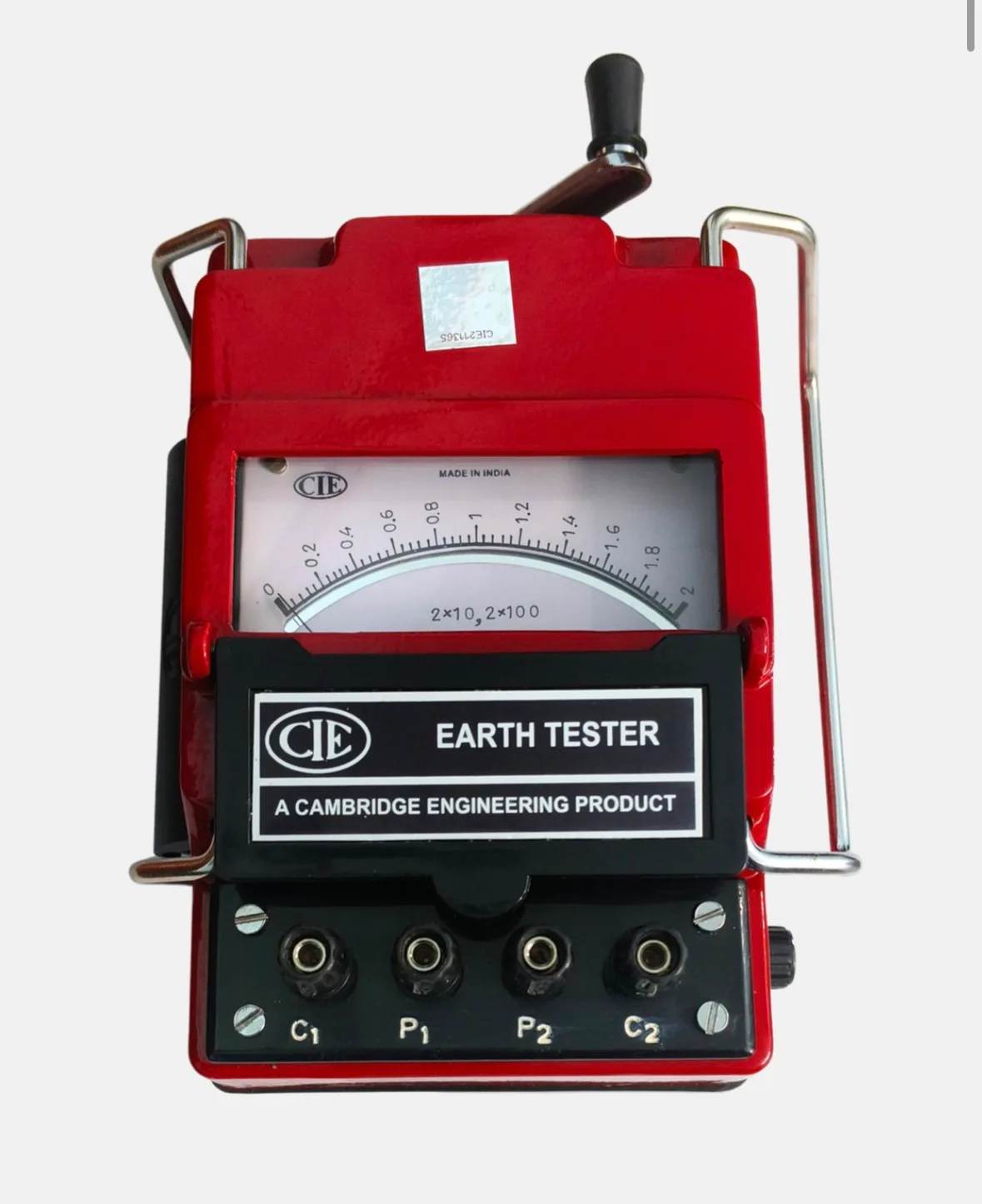
Featured CIE/222M
Analog Earth Tester - Metal Body
Hand-driven analog earth tester - 3-terminal (earth resistance) and 4-terminal (earth resistance + soil resistivity). ±5% accuracy per IS: 9223/1979.
Earth Resistance · Analog & Digital
Analog and digital earth resistance testers for 3-terminal earth resistance and soil resistivity measurement. Includes hand-driven analog instruments supplied as a complete kit, and digital models with direct numerical readout.
Not sure which one? Find your earth tester Compare models side by side → CIE/222M
Hand-driven analog earth tester - 3-terminal (earth resistance) and 4-terminal (earth resistance + soil resistivity). ±5% accuracy per IS: 9223/1979.
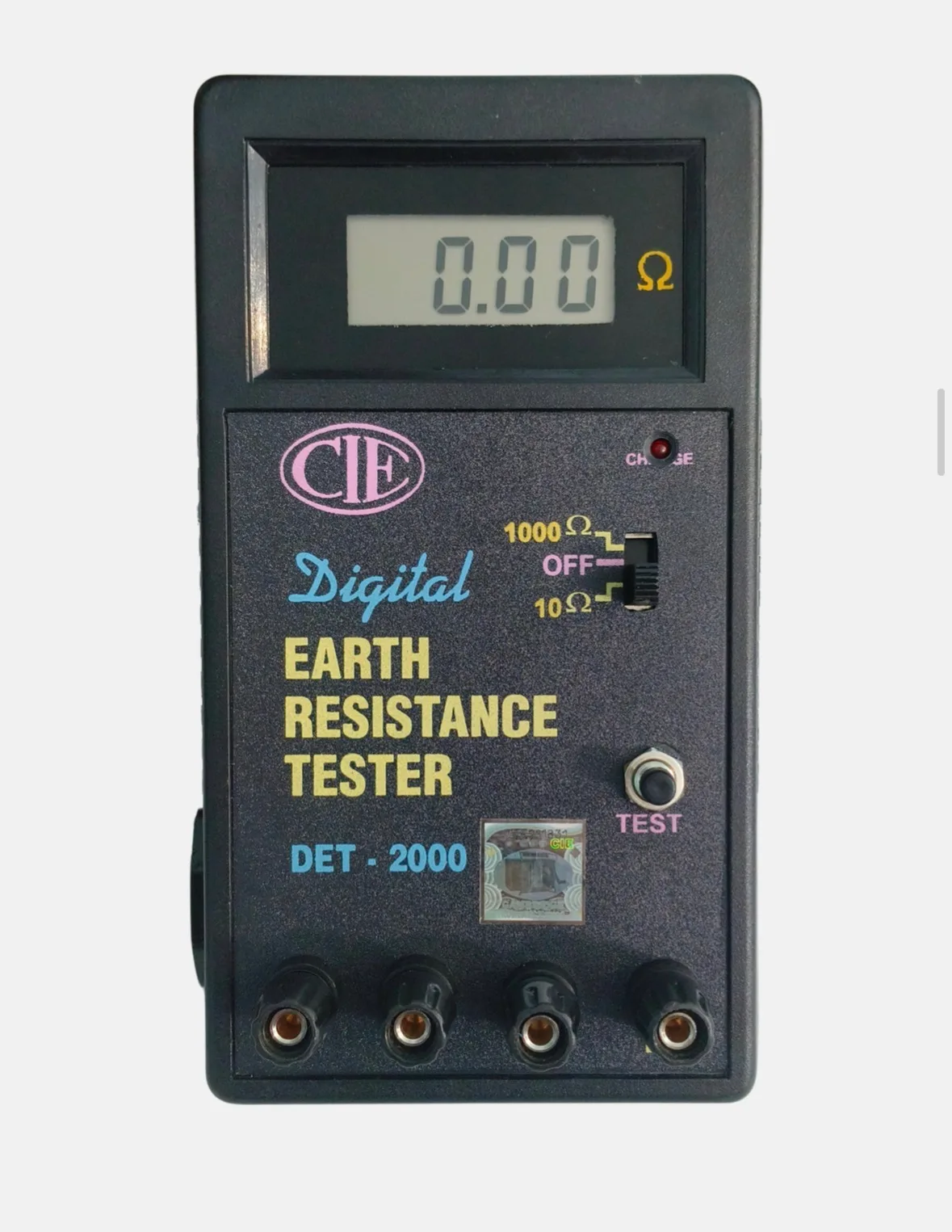
DET-2000
Rugged ABS-bodied digital earth resistance tester - 4-terminal, rechargeable Ni-Cd battery. Dual and triple range.
A poor earth connection is the most invisible and most dangerous electrical fault. This guide explains earth resistance, accepted limits, and how to measure it correctly.
PhysicsEarthing is not optional - it is the last line of defence between a fault and a fatal shock. Here's how every earthing system works and why testing it matters.
GuidesEarthing gives fault current a path to earth. Bonding gives dangerous potential difference nowhere to exist between two touchable metal parts. They're not the same thing.
Buying GuideA hand-driven tester never runs flat. A digital tester never needs a steady crank speed. Here's how to choose between them for your working conditions.
PhysicsWhen fault current enters the earth, it creates a voltage gradient around the point of contact - and anyone standing in it can become part of the circuit.
Earth resistance testing is mandatory at every electrical installation - from domestic earthing systems to substation earth grids - to ensure personnel safety and equipment protection. CIE manufactures both analog and digital earth resistance testers for a wide range of applications.
The CIE/222M is an analog, hand-driven earth tester supplied as a complete kit with earth spikes, wire spools, a carrying bag, and a hammer - everything needed for a 3-terminal earth resistance measurement in the field. It also supports 4-terminal Wenner method soil resistivity measurement, making it suitable for substation earth grid design. The DET-2000 is the digital companion: a 4-terminal digital earth resistance tester with direct numerical readout, eliminating the parallax-reading uncertainty of the analog instrument.
Earth testers are used by electrical contractors, PWD departments, power utilities, railways, telecom companies, data centre operators, and industrial facilities across India. CIE earth testers are supplied to customers in Kolkata, Howrah, Bhubaneswar, Rourkela, Cuttack, Sambalpur (Odisha), Raipur (Chhattisgarh), Ranchi (Jharkhand), and across Eastern, Northern, Western, and Southern India. Proper earth resistance testing is required by the Indian Electricity Rules and IS 3043.
Cambridge Instruments & Engg. Co. (CIE) - manufacturer of precision electrical test and measurement instruments in Howrah, West Bengal, India, established 1963. Pan-India supply: Kolkata · Howrah · Bhubaneswar · Cuttack · Bangalore · Chennai · Hyderabad · Mumbai · Pune · Delhi · Ahmedabad · Lucknow · Chandigarh · Ranchi · Raipur · Visakhapatnam · Nagpur.
Earth testers Finder
Analog hand-driven and digital earth resistance testers, side by side. Both can measure soil resistivity with the 4-terminal connection.
Results are matched against each model's published specifications. Always check the full specification page before ordering, and contact us if you are unsure.
Send your requirement by email or WhatsApp - we respond within one business day.